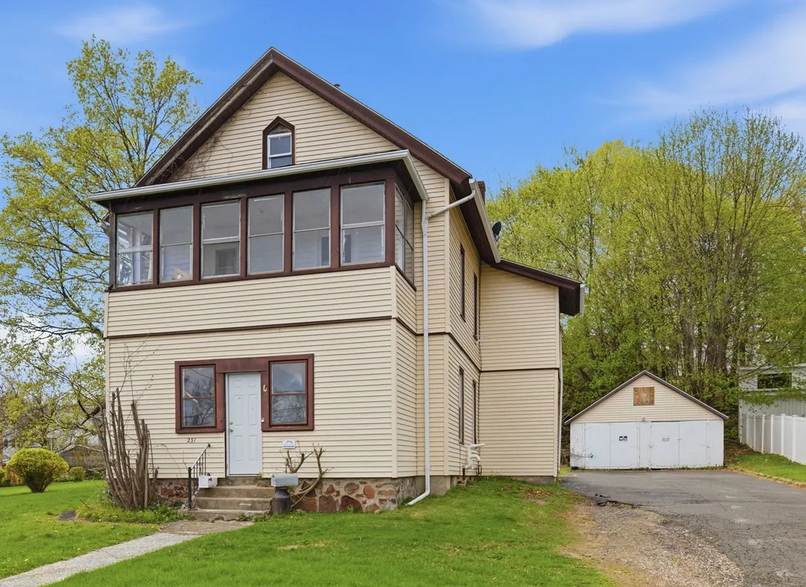
 So, the Great House Hunt is back on in earnest finally, and this weekend the Girls and I will be checking out some houses in Bristol. That’s a much larger town west of Hartford that happens to be smack dab in the middle of a Mestastic/Meshcore signal corridor that runs north from New Haven, CT all the way up into Maine, basically following the 91. (linguistic note: in New England, they call expressways by just the number, while in the SouthWest, we insert “the” in front of the number, and we call them “freeways”. “Go South on Eight” a Nutmegger says, while “Go down THE OCHO” is what I default to.)
  What is this “Meshtastic/Meshcore” thing? Well, they are two slightly different things, but in a nutshell, it is an open source, community built off-grid communication network using low-powered, low frequency radio to send text messages. It’s designed for setting up emergency communications quickly in places or situations where power and cell service are down, but since anyone can toss up a stand-alone solar-powered repeater anywhere that just sits there and relays traffic 24/7, many networks have become permanent infrastructure in certain areas, extending the range and reliability across cities and even connecting cities and states.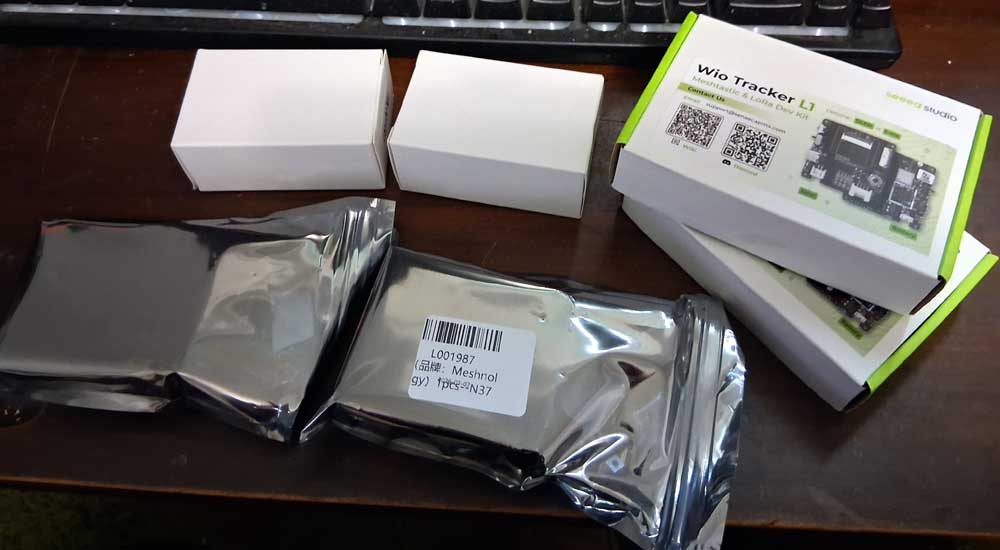
 Meshtastic and Meshcore are just different software variations of the same concept, and both run on the same radios – you can swap the firmware on the radios easily to use the network you prefer. Generally speaking Mestastic is intended for emergency communications and works best with relatively small networks and not a lot of users. Meshcore was developed later and implements more robust protocols allowing larger networks and longer distance with more hops between nodes. They don’t talk to each other, so it’s a matter of choice which you go with.
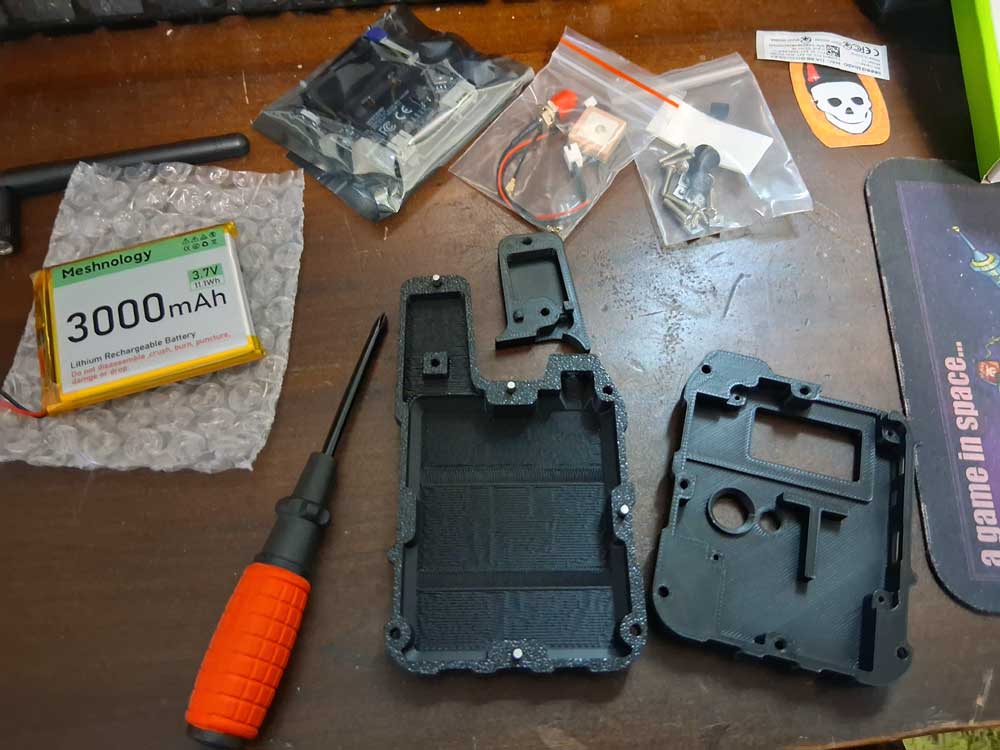
 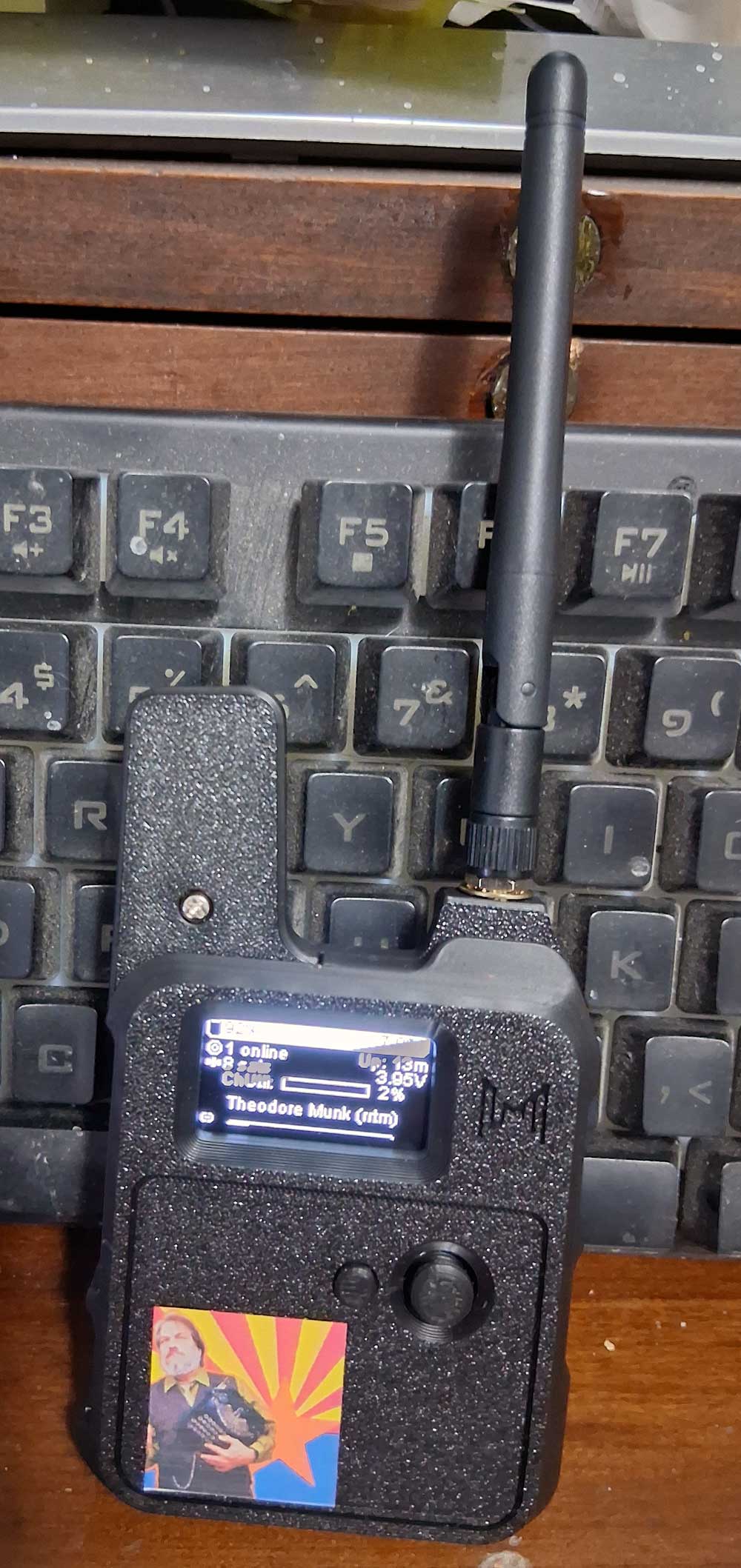 Anyway, I bought a couple of cheap WIO Tracker L1 kits and built the basic pair of radios so I could play around with it and do a little wardriving where we’re house hunting. I want to scope out what the off-grid comms look like in the area we end up in. It won’t be the *major* selling point, but it’s something I’ll consider – especially as I get less and less trusting of the internet and cell devices in my life becoming increasingly creepy and dangerous.
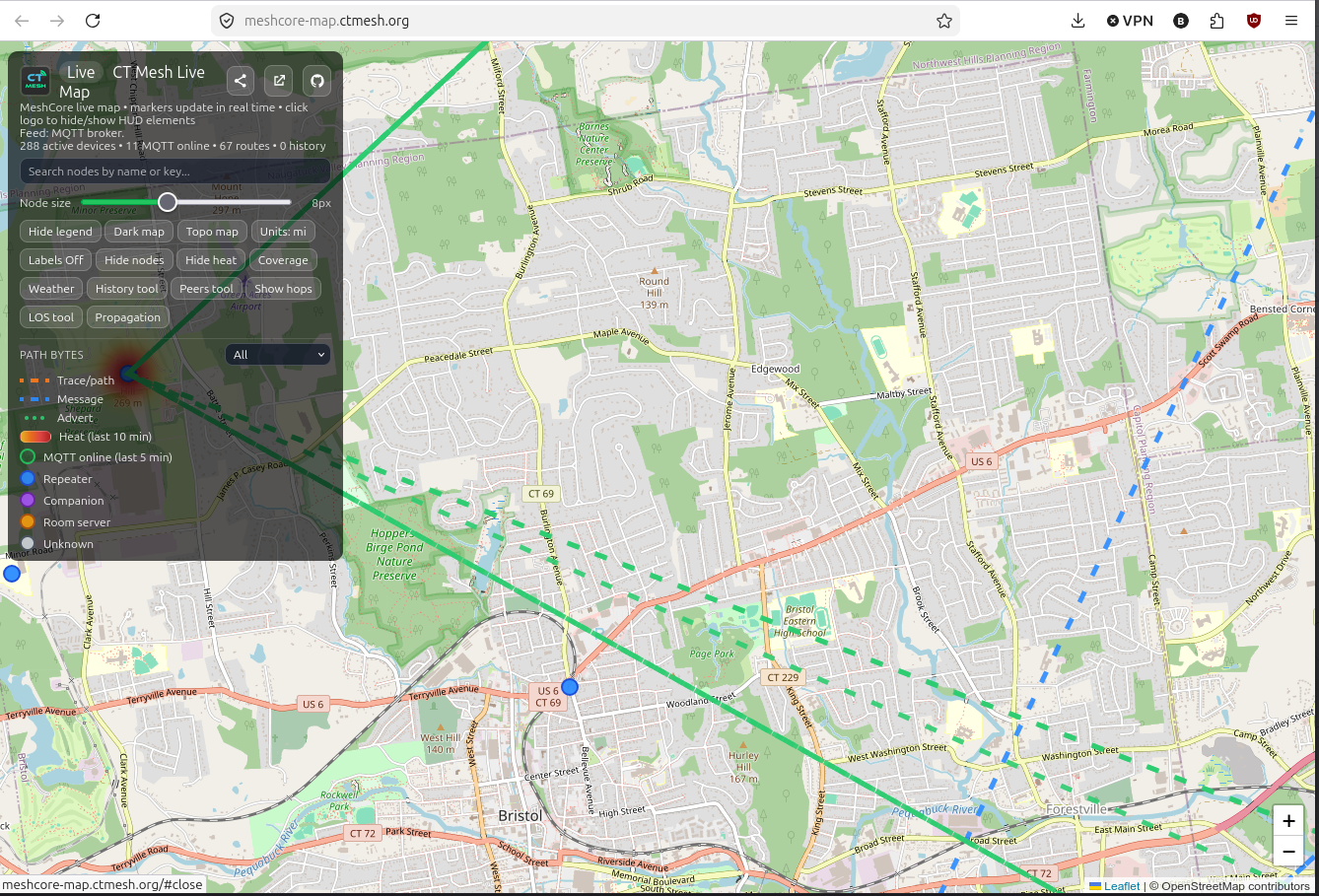
 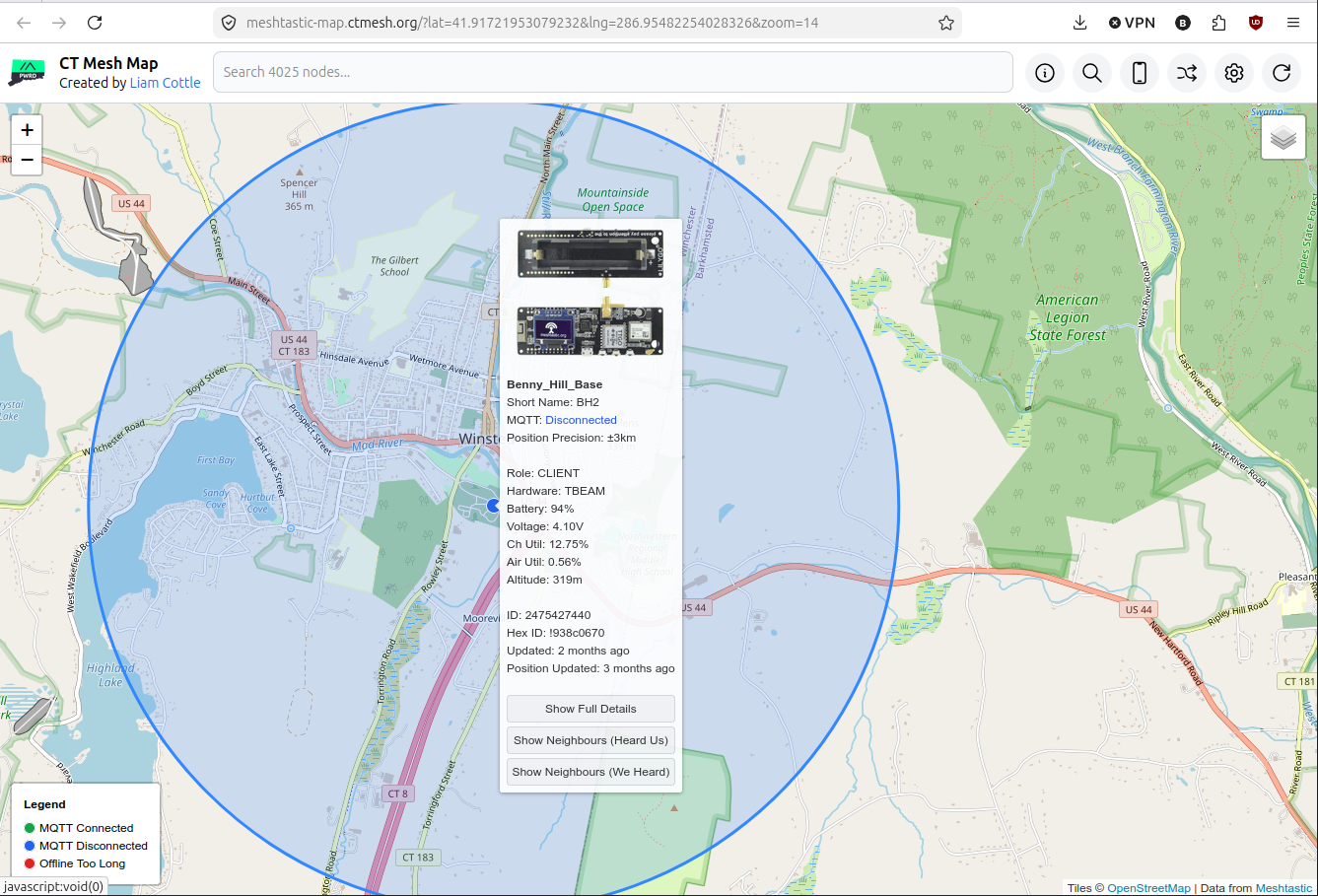 How about where I am here in podunk Winsted? Well, the Connecticut Mesh Map says there’s a big repeater just south of town that covers the entire town and a couple miles south on THE OCHO, and nothing else for dozens of miles. If it was actually on and relaying, it would extend the reach of these little handhelds to cover that entire area, but I’ve been checking since I built the radios, and it doesn’t appear to be up anymore, or it’s something that gets turned off and on when the owner needs it running. It’s just been about 9 hours since I started scanning, and there’s nobody else nearby. That will be most people’s experience when they get a radio like this if they aren’t in an area that’s already built out by enthusiasts with fixed repeaters. It’s lonely air out there in the sticks. However, since every radio is also a mini-repeater and new solar repeaters are going up every day, the networks are growing and reaching more areas. I think it’s interesting and worth exploring, and it reminds me a lot of early IRC days on 2400 baud dialup internet.
 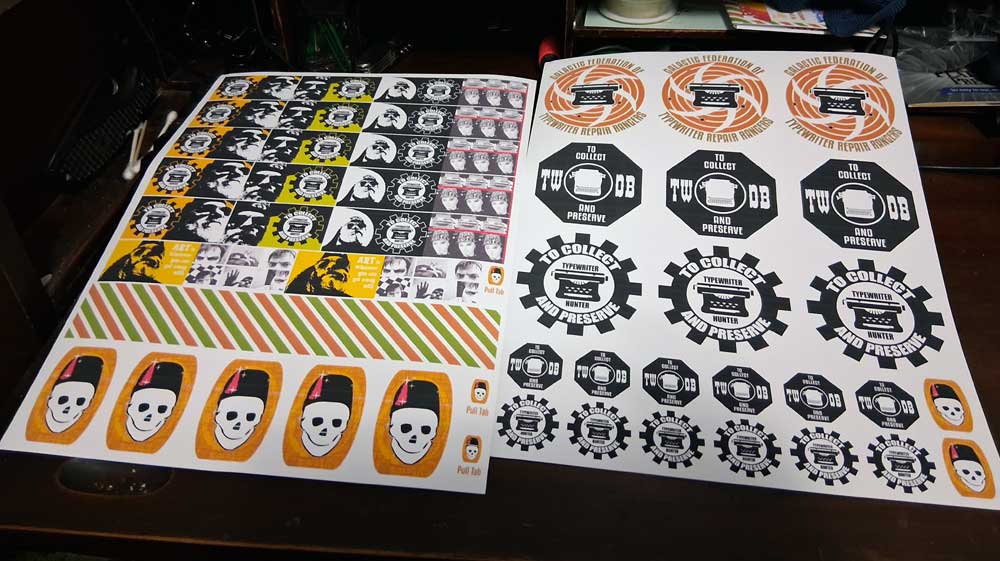 The first Sticker Packs have gone out – Time to make some more! :D
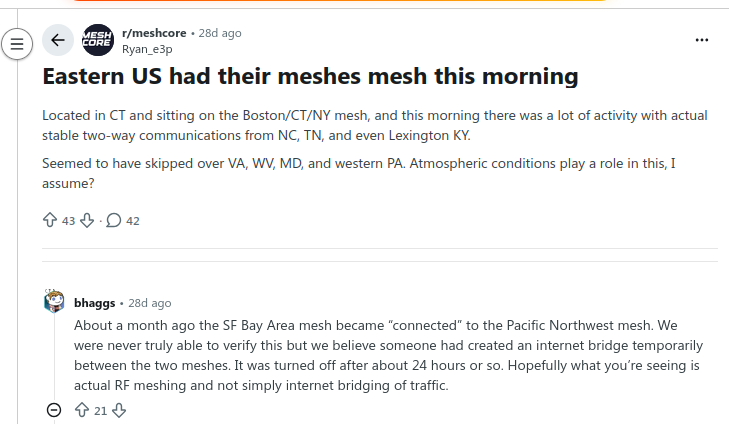 Ha! Apparently, very occasionally atmospheric conditions will improve low frequency radio bounce back to the ground enough that whole sections of the country’s Mesh nodes will connect for minutes to hours and allow messaging across several states. With time and increased adoption, it seems inevitable that the system will achieve critical mass fairly quickly.
Never heard of these networks before. I like the idea of a ground-up, alternative, decentered communication system.
and if you want to get real techy with it, you can run a cryptography/anonymity centered network stack like Reticulum over LoRa radios too.
https://reticulum.network
I’d echo Richard’s comments. I was curious enough to check on maps of upstate NY. At first I found nothing. Then, on another map, I noticed a couple of nodes close to a major university—but nothing that close to home (for the time being). I noticed on the Connecticut map that there was a lot of activity in some places. As well—I noted nodes sprouting up in the NYC area. Thanks for the post.
I’ve noticed on the node maps that it’s useful to note when the last time a node was heard from before assuming it’s a permanent node rather than a mobile one that’s gone already. There aren’t really any “central” location servers, so what gets reported on the maps are usually pings from nodes that happen to connect to one of the internet-connected community nodes and advertise its existence to it.
Oh, I should note that there are probably hundreds of nodes that don’t show up on the map, like my radios, for instance. They just haven’t connected to a node that reports its connections to one of the community-run location servers, or aren’t set up to advertise a location. So nothing on the map doesn’t necessarily mean nothing in the area.
Weirdly, today I did get a ping from another node, but it was in a DC suburb, many, many miles away. Don’t know enough about how this works to know why that would happen. :D
https://meshtastic-map.ctmesh.org/?lat=40.452101836253156&lng=285.5543661117554&zoom=15
Not long ago I ran into this video from the Modern Rogue. It gives a pretty good explanation of the network.
https://youtu.be/0AkQeyG4QmQ?si=A6VMds6ENhjB0gSr
Yeah, that’s a really good explainer, thanks! (:
I’ve been around MESH networks and do not know of any on LF. Most operate at in the 900MHZ band which is SHF just below Microwave. MESH networks are good extra tools during disasters. Our radio club was on a MESH in addition to our VHF & UHF repeaters.
MESH are near line of sight, the reason for repeaters, as many, and as high as possible.
Finally, MESH nets are much better and useful than other non-licensed services like CB and PRS, and even GMRS.
Good you live in (or are moving to) an active net area.
Happy MESHING (and maybe interface a typewriter to one….)
well, low compared to WiFi frequencies which are what I usually think of for data transmission. (:
The non-licensed part is especially interesting if something like the Meshcore network managed to reach continent-wide critical mass. Anyone can use it, and it’s easy and cheap to get into. I can imagine wide adoption.
Interfacing typewriter to one? Hmmn, about all I have left with I/O interface are the EP-22 and EP-44 Brother Thermal machines. I can’t say I had tremendous success printing to them, but I don’t see any reason they couldn’t theoretically be able to act as a printing terminal. I vaguely recall getting one of them to open a shell in Linux over USB/Serial & a null modem and running some commands, so they do echo keystrokes.
yeah, I’ve got CB & PRS radios and haven’t found them especially compelling for anything other than “Maybe when shit goes down”. Dead air everywhere, so no compelling reason to turn one on just to see who’s around. Mesh, however, offers the possibility of just seeing who’s around and chatting. That’s the thing that made CB so compelling when I was a kid.
“Ha! Apparently, very occasionally atmospheric conditions will improve low frequency radio bounce back to the ground enough that whole sections of the country’s Mesh nodes will connect for minutes to hours and allow messaging across several states.”
I remember reading about something like this a while back, a freak weather incident is how we have the oldest known live recording of the BBC’s Hi-Def television service before WWII.
Basically, in 1938 some engineers were tinkering on a British TV set in the RCA lab down in New York, when due to perfect atmospheric conditions, they somehow got a picture broadcast from the BBC in London! One of the engineers got a 16mm camera & recorded 4 minutes of TV, you can find it here:
https://archive.org/details/BbcTelevisionReceivedInNewYork-1938
This is the only footage we have of the BBC’s non-mechanical television service before WWII, believe it or not; Other recordings like this typically were shot with a film camera next to the actual TV camera on set.